Current Projects
The Hawkins lab primarily uses the zebrafish (Danio rerio) as an experimental system to investigate factors that regulate the body plan. Zebrafish have many features that make them a powerful model for genetics: they spawn readily in the laboratory and can produce hundreds of embryos from a single mating pair, they have a short generation time, and many genomic tools and resources have been produced to interrogate their biology. Zebrafish also have many advantages from a developmental perspective: they develop externally and have transparent embryos, allowing growth, cell, behavior, and gene and protein function to be observed in real time. These attributes allow us to follow the effect of genetic changes on the developmental process at the cell and tissue levels through embryonic and larval growth to the final adult form. We use the experimental tractability of the zebrafish in combination with insights gained from comparative approaches across the vertebrate tree of life to test the role of genetic changes on the generation of form.
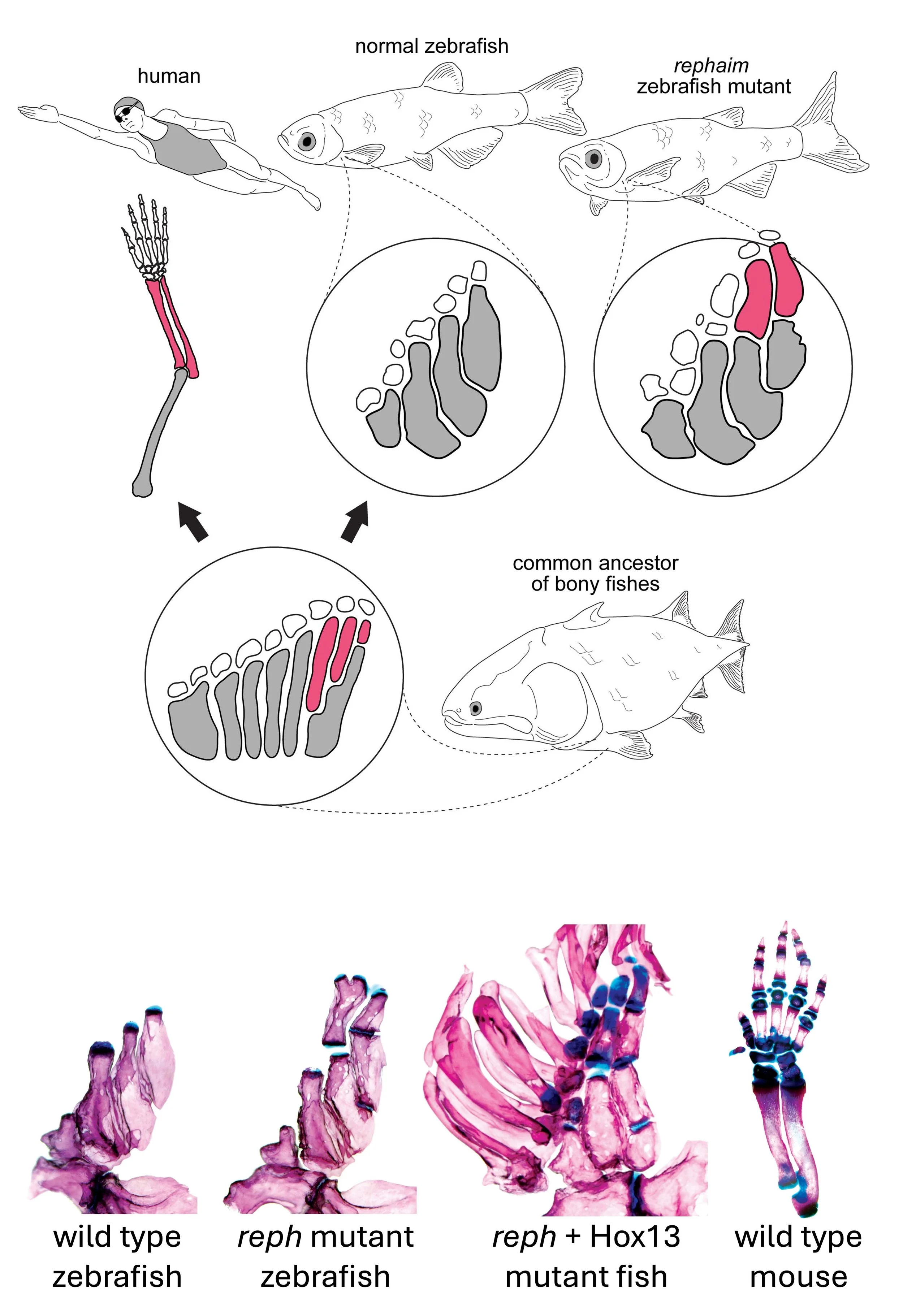
The fin-to-limb transition
The transformation of simple fins into complex limbs was an important transition in vertebrate evolutionary history, allowing the tetrapod lineage to leave the water and conquer terrestrial environments. Although the pectoral fin of a goldfish and the arm of a human are radically different in their anatomy, these structures share an evolutionary origin as they both are derived from the pectoral fin of their common fishy ancestor. From this ancestral condition, the lineage leading to tetrapods added new bones in an end-on-end configuration, turning the fins into fleshy limbs. We seek to understand the changes in gene function and development that underlie this elaboration from fins to limbs. Surprisingly, we find that the ability to express limb-like features is already present in the simple fin in a latent state, suggesting that some of the blueprint to make limbs was already being assembled in the common ancestor.
Highlighted Papers:
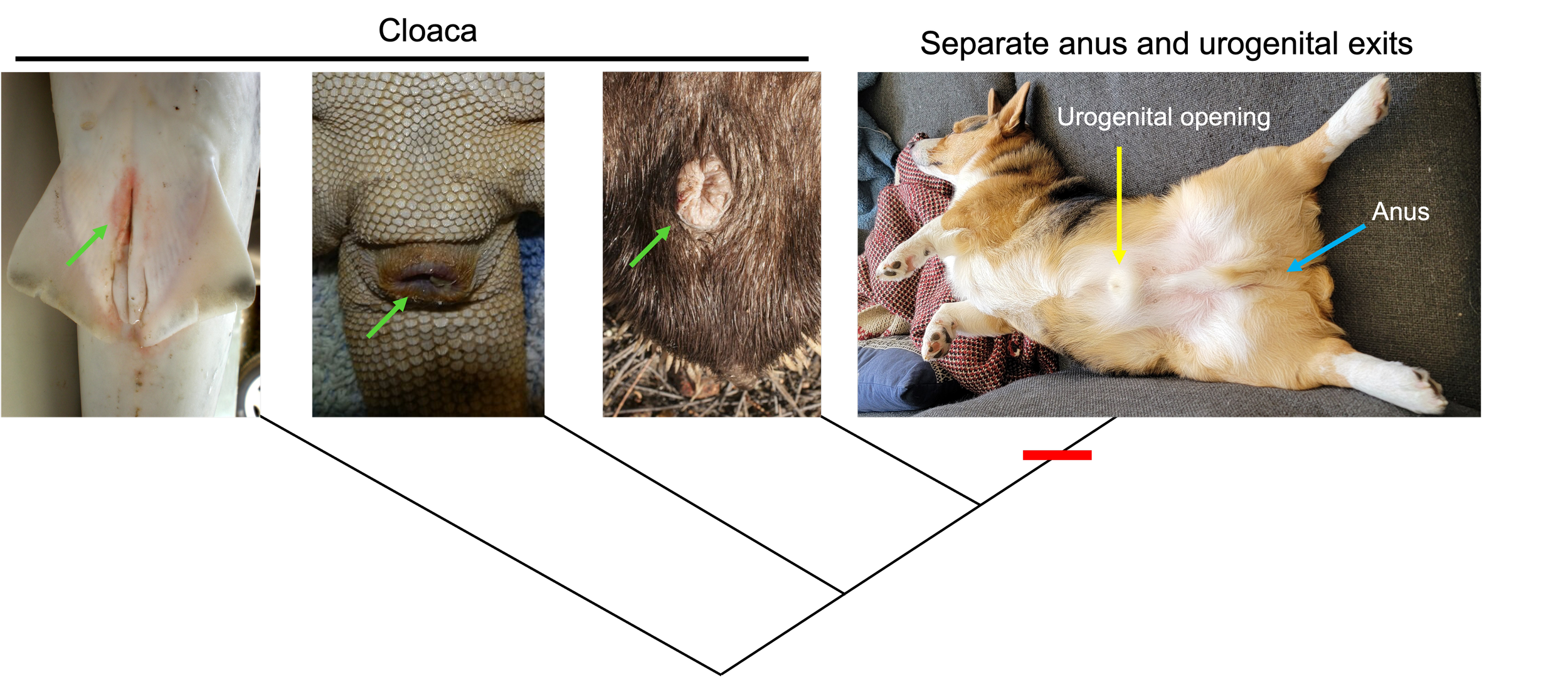
Partitioning of the cloaca: the origin of the independent anus
In most groups of vertebrates, the tracts of the digestive system, urinary system, and reproductive system connect inside the body before exiting through a single shared opening called the cloaca. However, several vertebrate lineages including placental mammals have separated these tracts, causing the digestive system to end in an independent opening called the anus. How this partitioning is controlled at the genetic and developmental levels is not known. Addressing this knowledge gap will enhance human health, as anorectal malformation, imperforate anus, and cloacal malformation occur in patients. We are pioneering the zebrafish model to address this critical but understudied body plan transformation.
Highlighted papers:
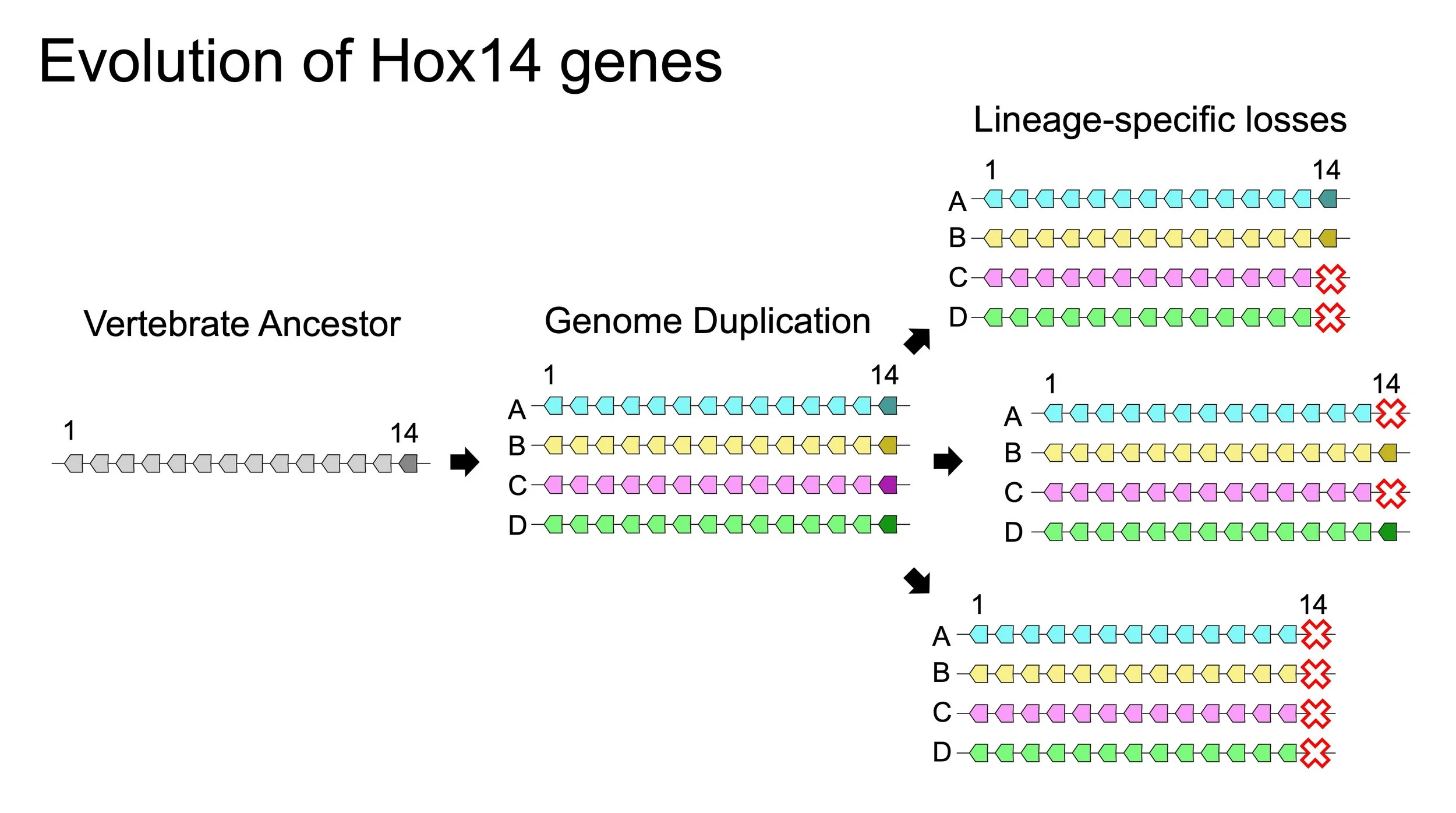
Hox14: the hidden function of an ancient code
The Hox genes are critical regulators of form that act to establish the body plan across the animal kingdom. These genes are typically arranged in clusters along the genome, and the position of an individual Hox gene within the cluster determines when and where the gene will be activated in the body. The final Hox gene in the cluster has a special position, as it turns on last and specifies the end of the body, and exerts control over the preceding genes. In vertebrate model species, Hox13 genes occupy this special terminal position. However, recent genomic analysis of non-model vertebrates has revealed the existence of an expanded Hox cluster with an enigmatic Hox14 in the final position after Hox13. Given the distribution of species which retain a Hox14 gene, it is clear that Hox14 has occupied this critical final position for most of vertebrate history. We are developing tools in model and non-model systems to investigate how Hox14 has shaped vertebrate biology.
Highlighted papers: